What’s the first thing you do when you get up in the morning?
Whatever it is, it’s probably either the same thing, or pretty close to the same thing, every day. We all have our own morning rituals.
Maybe you have a cup of coffee before you can do anything.
Maybe you hop out of bed and make it immediately. [this is my monthly challenge for June…trying to develop good habits]
Or you jump in a nice, hot shower.
Now it’s not a secret that I am NOT a morning person. I’m crabby. I’m indignant. I am in a long term, stable relationship with my bed, and I do NOT like leaving it. I can be downright unpleasant before 8 am. Even the cat steers clear.
Whatever we do in the morning though, at some point, we are going to come face to face with a mirror.
I have a full length one hanging on the wall next to my bed, and GOOD LORD IN THE MORNING, facing that thing is not pleasant experience. My hair’s all crazy, my eyes are squinty and puffy, and I usually have a look on my face that’s somewhere between a grimace and a scowl.
And that’s just from the neck up.
Some days, I just CAN’T look in the mirror as I walk past on my slog to the shower.
I just can’t.
Mirrors are honest little things, aren’t they? They don’t compromise. They don’t gloss over our defects like the beauty filter on my cell phone camera does.
That mirror shows every wrinkle, every roll, every grey hair, every flaw. And I mean EVERY flaw.
Some days, those flaws are all I see.
Those are the days that I slink off to the shower, the days I hide from my girlfriend, the days I wear pants and long sleeves even though it’s 90 degrees out…..
I look in the mirror and I am ashamed. So I hide.
If we’re honest with ourselves, we all have those days, don’t we? Days when we are less than proud, less than comfortable, less than happy with who we see in the mirror.
Do you ever wonder, when you look in the mirror, what other people see when they look at you?
I know I do.
I wonder, when my coworkers look at me, what do they see?
What do my friends see?
What does my girlfriend see?
Do they see what I see? Do they only see flaws? Do they see the parts of me that I want so desperately to hide? Or do they see something else? Something beyond the surface?
And that led me to another question…..
What am *I* really seeing when I look in the mirror? And why does what’s reflected make me feel so absolutely vulnerable?
Why are we so afraid to be truly *SEEN*?
We’re afraid to be seen – by ourselves, by others…..
So we hide.
We are so afraid of being vulnerable that we don’t look, can’t look, hope others don’t look. We do everything we can to make it seem like we have it all together — “I’m fine. Everything’s good. Thumbs up!” Just have to keep everybody at arm’s length, and no one will see that I’m actually a hot mess.
That might work for a while, but it’s no way to live.
We’re imperfect people. That’s just a reality of our lives. We’re human. We’re vulnerable.
We’re vulnerable to loss, to heartache, to doubt, to failures and flaws, to uncertainty and hurt.
We spend so much time hiding, protecting ourselves from being vulnerable, from being perceived as too emotional, too much of a mess, too this, not enough that. We spend so much time hiding that we can let our fear and discomfort become judgment and criticism…and those can fester into something toxic —
Shame.
Now, I’m not talking about guilt. Guilt isn’t necessarily a bad thing. It happens when there’s something wrong with something we’ve DONE. It can be a pang of conscience, or a knowledge that we’re out of covenant, and it can be a powerful motivator to fix a problem or issue.
No, I’m talking about SHAME – when we start believing that there’s something fundamentally wrong with who we are.
There’s nothing redemptive about shame.
It’s so toxic that it somehow gets into our core and makes us believe that there are parts of us that are just inherently not worthy, not lovable, that there are parts of us that we have to hide from the world at all costs, because if anyone ever found out, we’d be disowned and dropped in a heartbeat.
We can find ourselves falling into shame because we live in a world where we’re told over and over, either overtly, or more subtly, that we’re ‘not enough’ – we not smart enough, or pretty enough, or thin enough, or rich enough, or generous enough, or ‘normal’ enough – whatever that means.
It’s easy for us to start to think that we’re supposed to be perfect, to fit in, to be extraordinary – but not stand out too much — to have all our crap together…… and then we look and the mirror, and we’re just….not.
There are days when we DON’T have all our crap together, we AREN’T perfect, or thin, or straight, or whatever, and we look in that mirror and think to ourselves….my god, there is something really wrong with me.
I know that feeling all too well.
I didn’t even realize it for the longest time, but shame has occupied a huge place in my own psyche and in my history, and while I’ve made a lot of progress in addressing it, it’s still in there, and it always seems to come out at the most inopportune times – like when I look in the mirror in the morning and can’t see my own worth for all the flaws I’m reflecting back at myself, or I’m standing in the pulpit in a sleeveless dress, struggling to breathe in and get the words out, because I am terrified that someone is going to see me and judge me the way I judge myself.
I had no idea, when I signed up to preach a few Sundays back, that this was where mysermon was going to go, but we ended up there, and, if I can be really honest, it scared the shit out of me.
In the course of my 12 years as a minister, I wrote and delivered approximately 700 sermons. But that was the first time I’ve ever felt truly exposed, dare I say, vulnerable in the pulpit.
To talk with UUCV about truly SEEING and Being SEEN was to speak of vulnerability and, yes, shame, and that meant exposing what I still perceive as one of my own biggest weaknesses.
I know that I struggle with shame, with being ashamed, with wanting desperately to hide, and one of the traps of shame is that it tells me that I’m alone in that struggle, so I should keep my mouth shut and ride the status quo.
The rest of my brain knows that’s a load of fucking garbage. The rational part of me knows that it’s not truth – that I’m not alone in my insecurities. That we ALL, every one of us, has struggled, or will struggle, or is struggling with being seen. We’re all going to come face to face with shame at some point.
Maybe that’s why the concept of being in community is so core to my personal, ever-evolving, secular humanist i-don’t-know theology. And not I’m not talking about just any community, but being part of a BELOVED community.
There’s something about knowing that we’re all in this thing called life together, that we’re all yearning for connection that affirms our inherent worth and dignity as human beings that directly combats that shame-lie that we’re alone and not enough.
Brene Brown, one of my favorite writers, says that we are hardwired for connection, but for that connection to happen, we need to allow ourselves to be seen.
Perhaps that’s what drew me into UUCV – the fact that it is a faith that strives to lift up the gate and fling wide the doors in welcome. That they proclaim a message of wholeness as holiness, of unconditional love, of radical hospitality, affirmation, and hope. When the minister says, “you are welcome here. You are needed here. You are wanted here” every Sunday morning, she means it.
The first time I heard those words spoken from the pulpit, I felt both hope and fear. It sounded like such a beautiful sentiment of safety and acceptance, but it couldn’t possibly be true, right? Eventually, they’ll find out that I’m ___________ and they won’t want me.
I came to that place hoping against hope that the whole ‘inherent dignity and worth of every person’ thing was actually a THING.
And slowly, over time, I’ve realized that it IS.
It actually IS.
We can go there, to that holy place that is itself a mirror, and speak without fear of our not so perfect, not so tidy, not so successful lives.
Of not having it all together.
Of feeling like we don’t measure up.
And in doing so, we offer ourselves a little more room to be wholly human, and in turn, we offer others the grace to be wholly human as well. Yes, they do unapologetically celebrate the inherent worth and dignity of each person – and they, we, do so with honesty, with sincerity, knowing that being WHOLLY HUMAN means embracing all of ourselves – all of our joys and sorrows, all of our successes and failings, all of our triumphs and messes, as part of what it means to be human.
And we, in that celebration, remind one another that imperfection is part of being fully human, and it never diminishes, not by one bit, one’s inherent worth and dignity, one’s sacredness, one’s holiness.
We are perfectly imperfect, and we are unashamed.
When we can be vulnerable enough to speak of shame, and to shame, we dis-empower it. When we learn to recognize shame for what it is, stop hiding our beautiful selves, and start seeing ourselves as we see others, how others see us, we step out of the shadows and into the light of having our whole selves, all of us, seen, and known, and loved.
When I first started exploring the idea of maybe participating in leading worship, and maybe possibly preaching again, Aija said to me that she thought there was a sermon about shame inside me. I laughed at her and told her that she was wrong.
she wasn’t wrong.
It was totally in there.
I was just too afraid of being vulnerable to have the guts to preach it. And I didn’t think that the sermon I preached two weeks ago was going to be that sermon either, but the more I thought about it, the more I thought, how can we NOT address shame and vulnerability when talking about who we see when we really look at ourselves?
When we are able to get to a place where we can look ourselves in the mirror and say, ‘yeah. This is me,’ we are breaking down the walls of shame that keep us from reflecting the grace we freely offer to others, and that we so desperately need to accept for ourselves.
When we courageously own our stories and speak truth to the dark places in those stories, we can break the pattern of shame and hiding – by deciding that the way out of shame is NOT to hide from ourselves and others, but rather to hold on to each other as tightly as we can and pull out of it together.
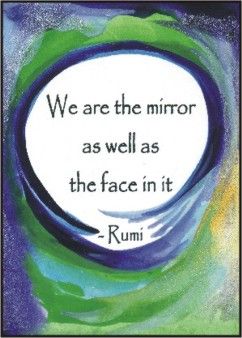
When we do that, we aren’t just looking in a mirror.
We BECOME the mirror for one another – reminding each other that we are wanted here, we are needed here, that we matter here.
That we are called to serve the world, and even though we aren’t perfect, we still have gifts to give. And if we see it reflected back at us enough, we can stand before that mirror, look ourselves in the face, and speak to our own shame, say to ourselves that
I am enough.
I have compassion for myself.
I am imperfect, but I am not broken.
I am beautiful.
I am enough, even when I feel like I’m not.
I am battle-worn, I am tired, and I am still enough.
I am worthy of all the grace that I’d show to someone else.
They say that to be seen is to be known, and to be known is to be loved.
May we allow ourselves to be vulnerable enough to be deeply seen, to love one another, and ourselves, with our whole hearts.
I am enough.
You are enough.
We are enough.
So very enough.
May it be so.
The live recording of the sermon version of this piece is available at https://soundcloud.com/uucv/june-3-2018-the-face-in-the-1
 VoyagersHeart